The Industrial Equipment Manufacturing Apps are the extension-based successor for Industrial Equipment Manufacturing. The apps version of the Industrial Equipment Manufacturing solution provides the same functionality as before and complies with Microsoft's Universal Code Initiative, which makes the solution future-proof.
Industrial Equipment Manufacturing extends Microsoft Dynamics 365 Business Central for the project-based style of manufacturing: the engineer, make, and assemble-to-order industry. Industrial Equipment Manufacturing builds on 20+ years of experience in this type of industry, closely following partner and customer requirements.
Product video
Overview
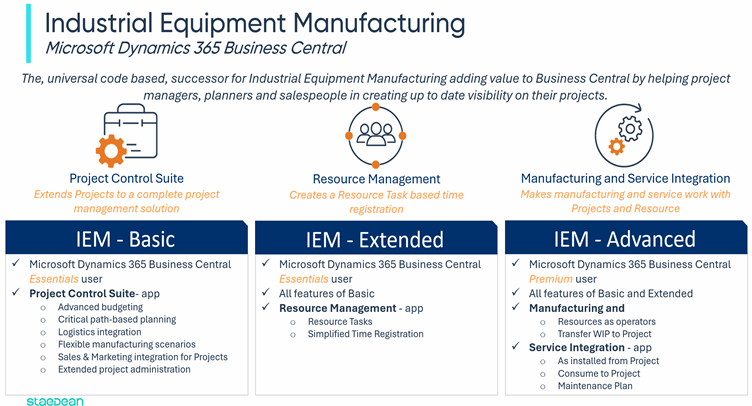
Industrial Equipment Manufacturing consists of the following modules:
Project Control Suite (IEM-Basic): extends the D365 BC Projects module to a complete project management solution. A project is temporary and undertaken to create a unique product, service, or result. To be successful, the project needs a plan (budget), a timeline, and accurate registration during execution. Only with these elements in place can visibility on the project's progress be properly forecasted.
Resource Management (IEM-Extended): extends the D365 BC Resource Planning module to a task-based planning and time registration module. To deploy people successfully to a project, clear assignment to tasks is required to enable insight into resource availability and correct registration of time spent.
Manufacturing and Service Integration (IEM-Advanced): integrates Project Control Suite and Resource Management into the D365 BC Manufacturing and Service modules, aligned with the D365 BC Premium license:
Manufacturing Integration: makes it possible to transfer work in progress from production to the project to have full visibility on all costs related to the project. Assigning resources as operators to production operations creates the basis for a Manufacturing Execution System (MES).
Service Integration: integrates Project Control Suite with the Service module to hand over the project deliverable to the installed base. This as-built or as-installed structure is the basis for efficient maintenance, repair, and overhaul services and can be extended to full Servitization.
Industrial Equipment Manufacturing features
To learn about the main features of Industrial Equipment Manufacturing, see the references in the following table:
To | See |
|---|---|
Understand the value chain and push/pull point in project manufacturing | |
Gain visibility into project activities and progress | |
Organize projects by using work breakdown structures | |
Manage project execution by using status controls and workflows | |
Integrate marketing and sales processes with project manufacturing | |
Plan materials, resources, and project activities | |
Manage different project-based manufacturing scenarios | |
Integrate warehouse processes with projects | |
Integrate manufacturing resources with project operations | |
Extend project-based manufacturing with service capabilities |
Apps for Industrial Equipment Manufacturing
Industrial Equipment Manufacturing apps:
Industrial Equipment Manufacturing integrations: