Industrial Equipment Manufacturing (IEM) for Microsoft Dynamics 365 Business Central supports the customer-driven (pull) style of manufacturing.
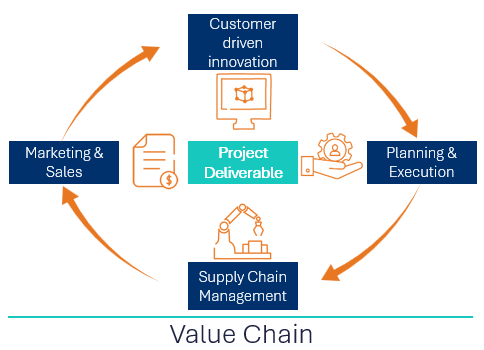
To support this style of manufacturing, Industrial Equipment Manufacturing adds functionality to each part of the value chain. The extent of being customer-driven is defined by the push/pull point.
The term push/pull is used in the supply chain to indicate from which direction demand is coming:
Push: initiates production in anticipation of future demand, independent from customer orders. Also known as Make to Stock.
Pull: initiates production from actual demand, driven by customer orders. Also known as Make to Order.
The push/pull point indicates how far into the ordering process customer needs are considered. Each system has its pros and cons and is closely related to the type of product. A push system is usually applied to retail products being mass produced. A pull system allows for customization and usually applies to complex equipment or tools. The advantage of manufacturing based on customer specifications is a reduction in stock obsolescence, finished goods inventory, and overall waste. This advantage comes at a cost because of the loss of economies of scale achieved in mass production.
The challenge for manufacturing companies in the make-to-order style is to find the right balance between flexibility in product specifications and cost of manufacturing. That balance is represented by the push/pull point.
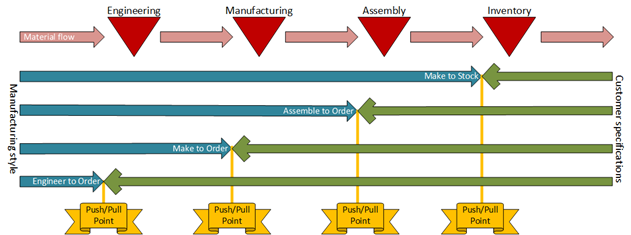
The most far-reaching form of customer-pulled manufacturing is engineer to order. In that manufacturing scenario, the push/pull point reaches all the way to the design of the product. Customer demand is subject to fluctuation, which can make the company vulnerable to under- or over-utilization of production capacities. To achieve more stability, companies attempt to move the push/pull point back by standardizing the product in building blocks that can be manufactured in small series. In that way, the company changes from engineer to order to make to order or assemble to order.
What remains important in these to-order styles of manufacturing is the pull from the customer: the needs of the customer are considered.
On the other end of this spectrum is project-based manufacturing, where the product is leading. Initially, a product may have been developed based on market trends and opinion: very much like an engineer-to-order project. When that product has been pushed successfully into the market, actual manufacturing starts in a project-oriented environment to create maximum efficiency. In this scenario, the push/pull point moves all the way to the completed product.
In all these scenarios, a software system must have the flexibility to move along with the push/pull point as companies, markets, and products develop. Industrial Equipment Manufacturing supports all these scenarios from engineer to order to project-based manufacturing. Industrial Equipment Manufacturing has been developed as an extension of Microsoft Dynamics 365 Business Central: previously known as Navision and Microsoft Dynamics 365 Business Central, drawing on 20 years of experience in supporting this style of manufacturing.
As the experience of Industrial Equipment Manufacturing customers shows, the product has been effective in helping companies become more competitive organizations that can turn quickly to meet changing customer needs and innovate collaboratively while supporting the complete value chain.