Pharmaceutical companies must correctly plan to purchase raw materials, API, and excipients considering manufacturing and quality activities that consume them.
Life Sciences Supply Chain Management module allows using an ad-hoc algorithm to calculate and propose safety stock for items, considering future demands and material sampling plans.
The algorithm can be run by going to Master planning > Master planning > Run > Safety stock calculation. The safety stock proposal is calculated according to the following formula:

The following parameters can be used to manage and opportunely fine-tune the algorithm results:
Lead time factor: defines the extension of the time window the algorithm considers in terms of multiples of the item’s purchase lead time.
Delay: defines the number of days added to the running date to move the time window defined using the Lead time factor field.
Master plan: defines the master plan used by the algorithm to perform its calculation.
Requirement multiplication factor: defines the weight of the first part of the algorithm formula (the one that considers future requirements).
Sampling multiplication factor: defines the weight of the second part of the algorithm formula (the one that considers the item’s sampling plan).
Include backorder purchases: includes or excludes delayed purchase orders in the algorithm’s calculation. This parameter influences only the sampling quantity and can be enabled only if the Delay field is set to “0”.
The following image represents how times are considered by the algorithm, depending on the item’s lead time and the algorithm parameters:
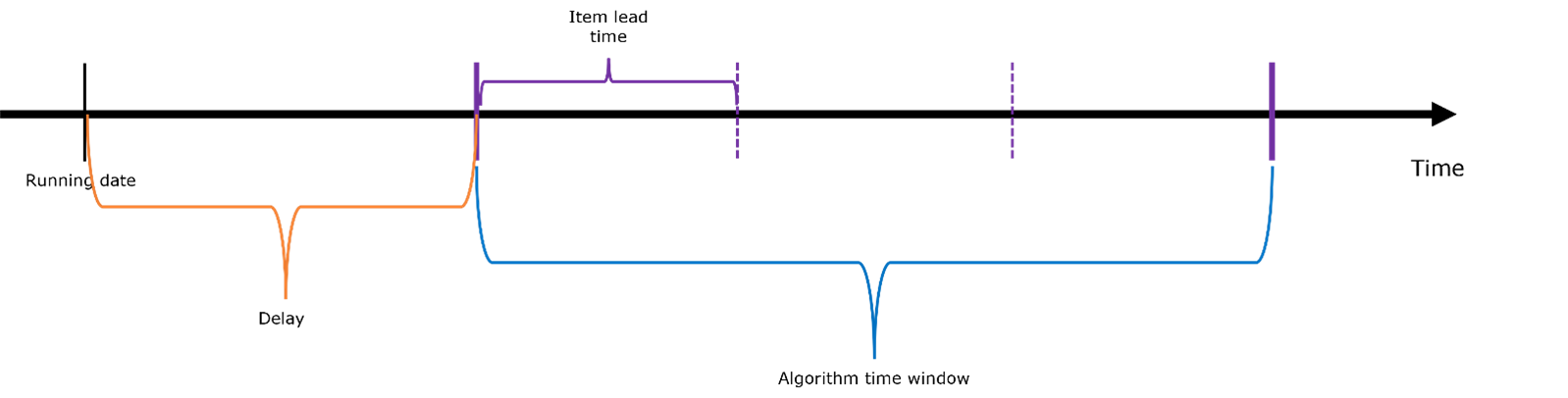
Calculations are made considering requirements and actual or planned orders created to satisfy them by a specific master plan (specified in the Master plan parameter). Therefore, results are strictly related to the last master plan run available in the environment.
Additional parameters used by the algorithm are the Use in safety stock algorithm and the Container unit defined in the item’s quality associations and the item sampling configurations. The algorithm leverages those to correctly estimate the sampling quantity based on the incoming planned and actual purchase orders. Please refer to the Advanced Quality Management™ implementation guide for additional information.